Refs and the DOM in React JS.
In this chapter, you will learn about Refs and the DOM in React JS. Refs method provides a way to access DOM nodes or React elements created in the render method. In the typical React data-flow approach, props are the only way that parent components interact with their children. To modify a child, you re-render it with new props. However, there are a few cases where you need to imperatively modify a child outside of the typical dataflow. The child to be modified could be an instance of a React component.
When to Use Refs?
There are a few good use cases for refs:
- Managing focus, text selection, or media playback.
- Triggering imperative animations.
- Integrating with third-party DOM libraries.
Let’s create an example of focusing on an input field.
Step 1:
Create the file src/components/manager/Manager.js if you have it already paste the below code snippet
import React from "react";
import './Manager.css'
import PropTypes from 'prop-types'

const manager = props => {
  return (
    <div>
      {props.isManagerLoggedin ? (
        <div>
          <h2>Welcome to your dashboard</h2>
          {props.employee.map(item => (
            <li key={item.name}> Name: {item.name}, ID: {item.empId}</li>
          ))}
          <button onClick={props.logout}>Logout</button>
        </div>

      ) : (
        <div>
          <button onClick={props.login}>Login</button>
        </div>
      )}
    </div>
  );
};

manager.propTypes = {
  isManagerLoggedin: PropTypes.bool,
  login:PropTypes.func,
  logout:PropTypes.func,
  employee:PropTypes.array
};

export default manager;
Step 2:
Create the file src/components/hoc/Container.js if you have it already paste the below code snippet
import React from 'react';

const container = (props) => (
    <div className={props.divClassName}>
        {props.children}
    </div>
);

export default container;
Step 3:
Create the file src/App.js if you have it already paste the below code snippet
import React, { Component } from 'react';
import './App.css';
import Manager from './components/manager/Manager';
import Container from './components/hoc/Container';
class App extends Component {
  constructor(props) {
    super(props);
    this.login = this.login.bind(this);
    this.logout = this.logout.bind(this);
    this.state = {
      isManagerLoggedin: false,
      employee: [
        {name:'Stark', empId:'123'},
        {name:'John', empId:'124'},
        {name:'Mickel', empId:'125'},
        {name:'Clark', empId:'126'}
      ]
    };
  }

  componentDidMount() {}

  login = e => {
    this.setState({ isManagerLoggedin: true });
  };

  logout = e => {
    this.setState({ isManagerLoggedin: false });
  };

  render() {
    return (
      <Container divClassName='App'>
        <h1>Welcome to react JS tutorial</h1>
        <Manager
          isManagerLoggedin={this.state.isManagerLoggedin}
          login={this.login}
          logout={this.logout}
          employee={this.state.employee}
        />
      </Container>
    );
  }
}

export default App;
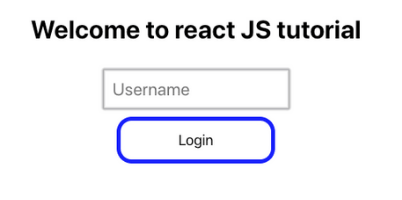
Hit the URL: http://localhost:3000/, as we can see in the below output, it automatically focuses an input field.
One thought on “Refs and the DOM in React JS”
Comments are closed.